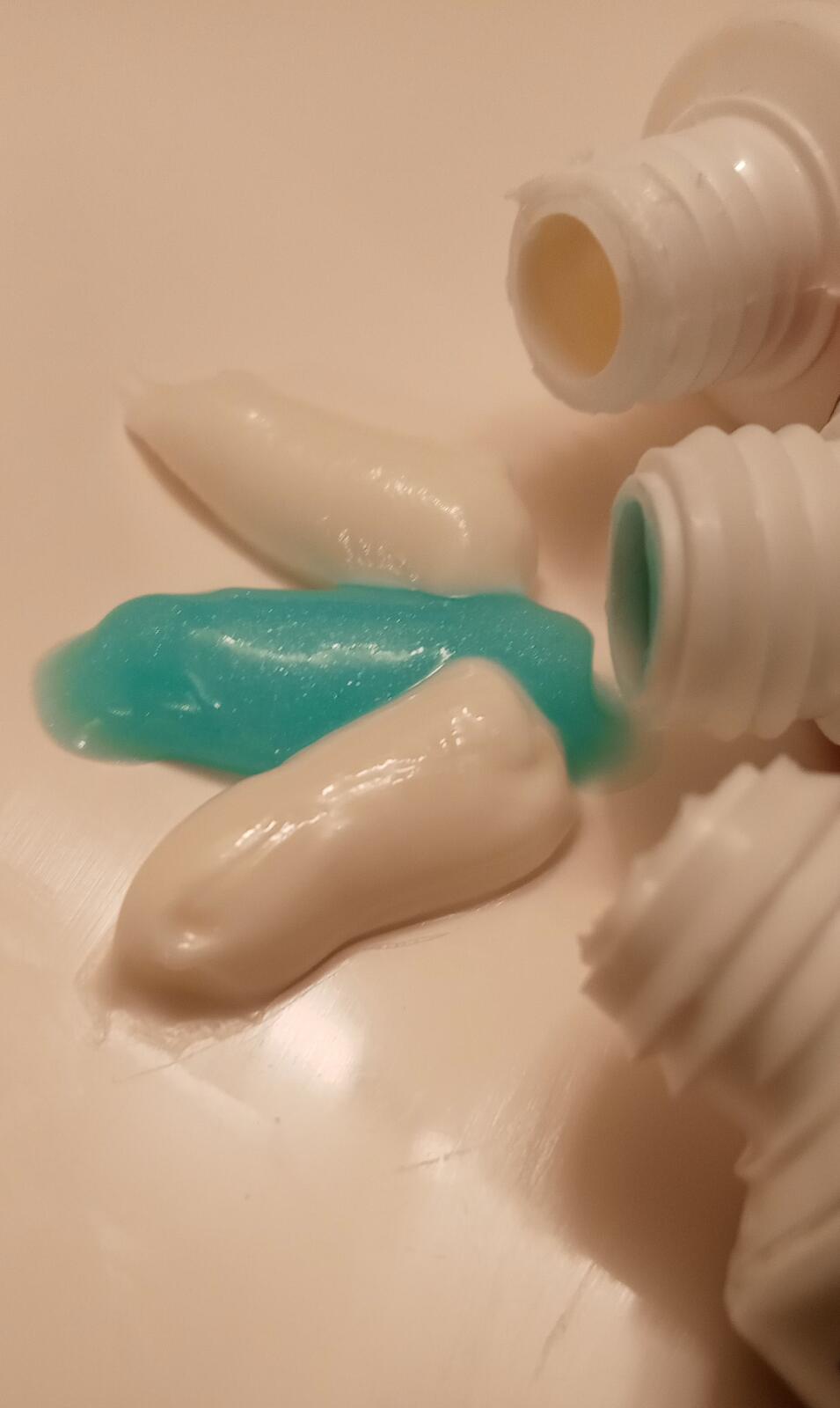
I get lots of questions from patients about toothpaste. The most common questions are about which toothpaste to use and which toothpaste I use.
Unless you have a specific dental condition, such as tooth sensitivity, or a condition for which you need a prescription strength toothpaste, I don't recommend any particular brand or kind. Personally, I use the cheapest brand on sale that has sodium fluoride in it. However, to treat my intermittent tooth sensitivity, I use a toothpaste that contains potassium nitrate. (These toothpastes may be labeled "sensitive" or "sensitivity." Check the "Drug Facts" label on the box for the active ingredients.) In the office I use a professional formula to pre-treat patients who have tooth sensitivity. These products work by blocking pores in the dentin portion of your tooth where sensitivity can occur due to receding gums or worn enamel.* (Sensitivity may also be due to cavities or build up of tartar (also called hardened plaque or calculus) in which case toothpaste won't help.)
Another question I get is about whitening toothpaste. Unless a toothpaste contains hydrogen peroxide or carbamide peroxide, ingredients that actually bleach the teeth, any whitening effect is more likely from consistently brushing your teeth. Only the active ingredient supplies the desired effect of the product. Some toothpastes contain triclosan or stannous fluoride, for example. These have anti-bacterial properties that may help with gingivitis. There are also many "inactive" ingredients in toothpaste that contribute to the abrasiveness, smoothness or taste of the product. Sodium bicarbonate, also known as baking soda, and silicates are stain removers found in toothpastes.
"Re-enamelizing" or "re-mineralizing" is a question of interest as well. Once enamel is gone it's gone. However, fluoride can bind with minerals in the tooth structure to form a protective layer on the surface of the tooth. This is the basis of the claim that toothpaste prevents "de-mineralization" of the teeth or encourages "re-mineralization," and the reason that fluoride "strengthens" teeth. Fluoride also has anti-bacterial properties and so may help to reduce germ levels which contribute to the formation of acid.
How about the abrasiveness of toothpaste? Can toothpaste itself damage the teeth? I recently found some data regarding the RDA or Radioactive Dentin Abrasion of toothpaste, also referred to as "Relative" Dentin Abrasion. This is how abrasiveness of toothpaste is rated in a lab setting and must be in a certain range to be approved by the Food and Drug Administration (FDA) and get the seal of the American Dental Association (ADA). Unfortunately, while there are some online charts that cite these numbers for toothpastes, I can't verify the year or original source of the information. (If I do, I'll post it.) Some toothpaste is definitely more abrasive than others. What I recommend is calling the manufacturer directly and asking them for the RDA, or abrasiveness rating, of the product. This is sometimes considered to be a "trade secret." They may just give you a range.
Whatever type of toothpaste you use,
what is most important is the mechanical removal of plaque from your teeth. This means that you should be
gently brushing at least two times a day for two minutes using a
SOFT toothbrush with a
small amount of toothpaste. The goal is to remove plaque, which is a colony of germs attached to your teeth, before it hardens. Just like hand washing, toothbrushing must be done thoroughly to ensure the removal of the germs.
Regular brushing of the teeth is more important than the type of toothpaste you use. Just take care to be gentle.
If the bristles on your toothbrush are smashed after using it two times you are brushing too hard! If you are an "agressive toothbrusher" an electric toothbrush is probably NOT for you.
If you are are only brushing for 30 seconds you are not brushing long enough.
If you are using so much toothpaste that it only takes you a week to go through the entire tube, you are using too much.
When you brush your teeth, you should also be brushing your gums, another reason to be gentle.
For a great description and illustration of how to properly brush (from the American Dental Hygienists' Association website) go to:
http://www.adha.org/resources-docs/7221_Proper_Brushing.pdf
Please use the comment section if you have any questions or comments or if you'd like to share the name of your favorite toothpaste!
*You should discuss gum recession, enamel wear and tooth sensitivity with your dental hygienist or dentist.
This information is not intended to treat or diagnose any dental or medical condition. Please contact your medical or dental professional for treatment and information.